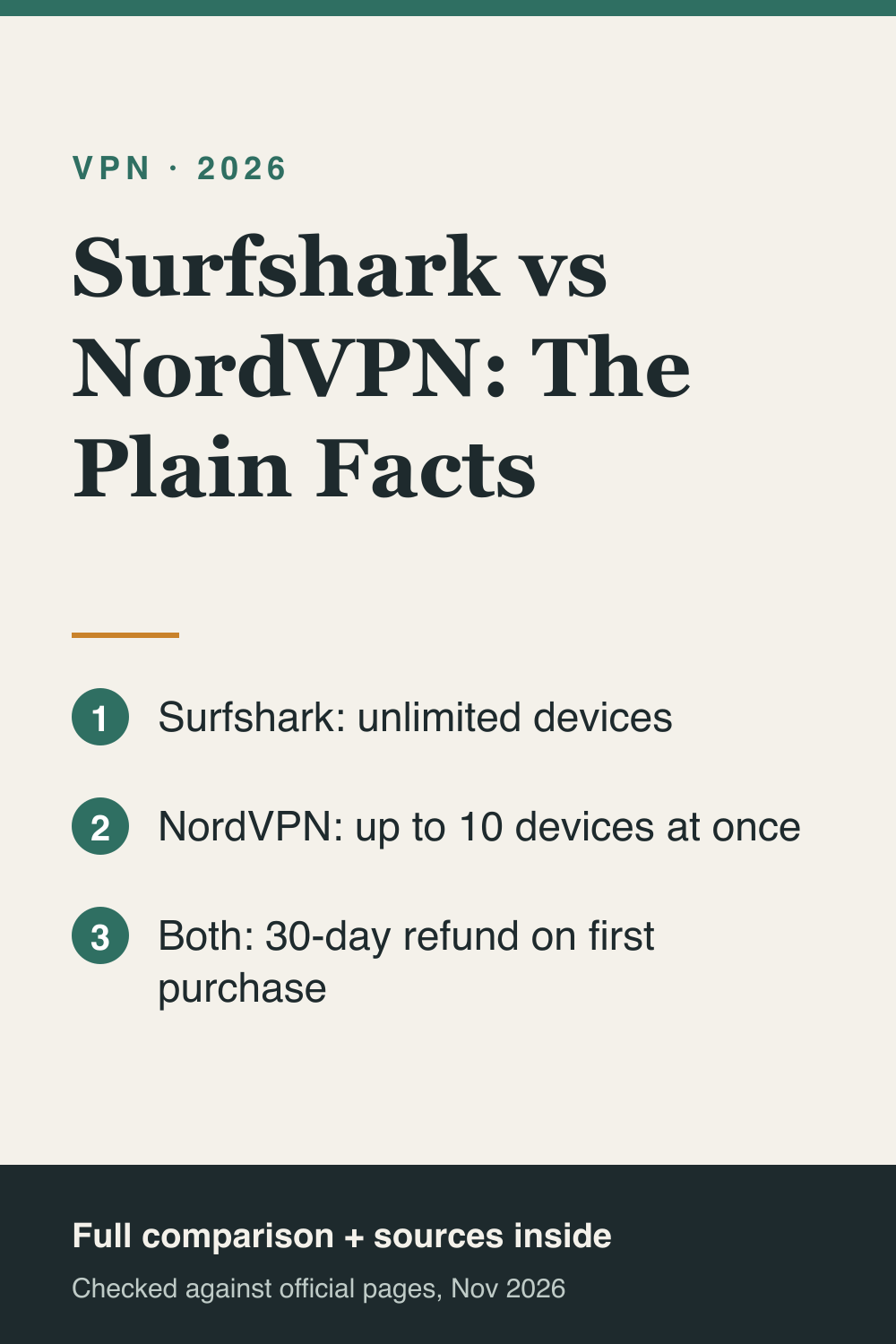
Surfshark vs NordVPN (2026): 5 VPNs Compared on Official Terms
The problem with picking a VPN
Most people start looking for a VPN for an ordinary reason. You work from a café or a hotel and the Wi-Fi has no password. You share a laptop, a phone and a tablet across a family and want one subscription to cover them. Or you are tired of a VPN ad on every video telling you that one service is number one.
The second problem shows up at checkout. The price on the banner is usually an introductory price for a long first term, and the renewal price is often much higher and printed in smaller type. Refund promises also come with conditions that only appear in the terms of service.
This guide compares five VPNs: Surfshark, NordVPN, ExpressVPN, Proton VPN and Mullvad. We did not run speed tests and we do not describe how the apps feel to use. We read each provider’s pricing page, feature pages, help center and terms, and wrote down only what those pages state. Where a provider’s own pages disagree with each other, or where we could not read a number, we say so instead of guessing.
Who this guide is not for
A consumer VPN changes who can see your traffic. It moves trust from your local network and internet provider to the VPN company. It does not make you anonymous. Websites can still recognize you through accounts you log into, browser fingerprints and cookies. This guide is not the right starting point if:
- You need protection from a state-level adversary. If your safety depends on not being identified by a government or a well-funded attacker, a commercial VPN alone is not enough. Look into tools designed for that threat model, such as the Tor Browser, and guidance from digital security organizations that work with journalists and activists.
- You need to reach your company’s internal network. Remote access to office servers is handled by your employer’s own VPN or zero-trust system. A consumer VPN will not connect you to it, and installing one on a work device may break your company’s policy.
- You want to get around rules you agreed to. Using a VPN can break the terms of streaming services, games or workplaces. None of the providers below can promise access to any specific service.
- You want a free VPN with no limits. Only one provider here (Proton VPN) lists a free plan, and its free tier is limited.
How we compared: three criteria
We kept the method small on purpose. Each criterion is something you can check yourself on the provider’s site before paying.
1. What you really pay, and for how long. We recorded the introductory price, the length of the first term and the renewal price where the official pricing page showed them in US dollars. Several providers sell a two-year term (sometimes with extra months) at a large discount and then renew at a higher yearly rate. When a pricing page did not show a dollar price to us, we did not fill one in from memory or from review sites.
2. How many devices one subscription covers, and the refund window. A household with five phones and two laptops has different needs from one person with one laptop. We also recorded how many days you have to ask for your money back and the conditions attached to that promise, such as “first purchase only.”
3. What the provider publishes about logging and where it is based. Every VPN says it keeps no logs. What differs is whether an outside firm has checked that claim, how recently, and which country’s law the company says it operates under. We list the audits each provider announces on its own site. We did not read the full audit reports, and several providers make them available only to logged-in customers.
We did not score server speed, streaming access or app design, because those would require hands-on testing that we did not do.
Comparison table
| Provider | Simultaneous devices | Money-back window | Price shown on official page (USD) | Stated base / jurisdiction | Published no-logs checks (provider’s own pages) |
|---|---|---|---|---|---|
| Surfshark | Unlimited (free trial: 3) | 30 days, first purchase only | Pricing page did not show USD to us; see the current price on the official site | Surfshark B.V., Netherlands; terms governed by British Virgin Islands law | Deloitte assurance in 2023 and 2025 |
| NordVPN | Up to 10 | 30 days, first purchase only | Pricing page could not be read; see the current price on the official site | Panama (help center); parent Nord Security in the Netherlands | Deloitte Audit Lithuania; fifth engagement announced February 2025 |
| ExpressVPN | 10, 12 or 14 depending on plan | 30 days for new users | Basic $83.72 for the first 28 months, then $99.95/year | British Virgin Islands | KPMG, September 2022 and December 2023 |
| Proton VPN | 10 on paid plans; 1 on Free | 30 days on paid plans | Plus $35.88 for the first 12 months, then $83.88/year; Free plan $0 | Switzerland | Securitum, yearly since 2022 (fifth in 2026) |
| Mullvad | Up to 5 | 14 days (cash excluded) | €5 per month flat, no sales | Sweden | Radically Open Security infrastructure audit, August 2023 |
The ExpressVPN, Proton VPN and Mullvad prices above are the figures we saw on their pricing pages today. Introductory prices apply to the first term only, and every provider can change them.
Surfshark vs NordVPN
These two are the names most people end up choosing between, so here is a direct comparison on facts each company publishes.
Device limits
This is the clearest difference. Surfshark’s VPN page says you can “protect unlimited devices with a single subscription.” Its pricing page notes that free trials are limited to 3 devices, so the unlimited figure applies to paid plans.
NordVPN’s help center says you can connect “up to 10 devices to a single NordVPN account at the same time.” The same article adds a detail many people miss: no more than five of your devices can be connected to one server at once, so a sixth device has to use a different server. NordVPN also points out that a VPN set up on a router uses one slot while covering the devices on that network.
For a single person, 10 devices is plenty. For a large household or a small office that does not want to set up a router, Surfshark’s unlimited policy removes the need to count.
Money-back guarantee
Both offer 30 days, and both limit it to your first purchase.
- Surfshark’s terms of service say the guarantee “applies only to your initial purchase,” that recurring payments are non-refundable, and list exclusions: subscriptions bought through most third-party resellers, payments made with prepaid or gift cards, and add-ons such as Alternative ID.
- NordVPN’s refund policy says the 30-day guarantee is “for new subscriptions,” must be requested within 30 days of your first purchase, and does not cover renewals unless local law requires it. NordVPN says it cannot refund payments made through the Apple App Store; those go through Apple.
If you think you might want a refund, buy directly from the provider’s website rather than through an app store or a reseller.
Plan structure
Surfshark sells three tiers. According to its own plan guide:
- Starter: the VPN, Alternative ID, Clean Web (ad and cookie pop-up blocker), Bypasser (split tunneling), Dynamic MultiHop and unlimited connections.
- One: everything in Starter plus Surfshark Antivirus, Surfshark Alert, scam protection and web content blocking.
- One+: everything in One plus Incogni data removal, and identity theft coverage for eligible new customers in the US.
Surfshark’s plan guide says all plans include the same core VPN features, including a kill switch. Its pricing page offers 1-month, 1-year and 2-year billing, and the 2-year option we saw was billed once for the first 27 months, then yearly at the “applicable renewal price.” The page did not print that renewal amount. When we checked, the pricing page showed prices in a local currency rather than US dollars, so we are not printing a dollar figure here.
NordVPN’s help center says it offers 2-year, 1-year and 1-month plans, that the 1-year and 2-year plans are paid in full up front, and that prices are updated on its pricing page. We could not load that pricing page, so we cannot list NordVPN’s tiers or prices. Check both companies’ checkout pages for the renewal price before you pay.
Features listed on official pages
Surfshark lists WireGuard, IKEv2, OpenVPN and its own Dausos protocol on its VPN page, along with Clean Web, Bypasser, Rotating IP and Dynamic MultiHop.
NordVPN’s help center lists NordLynx (built on WireGuard), its own NordWhisper protocol, OpenVPN and IKEv2/IPsec. It also lists an automatic kill switch, DNS leak protection, real-time protection against malware and harmful websites, Double VPN servers, Onion Over VPN, obfuscated servers, Meshnet, Dark Web Monitor, and a dedicated IP option.
Both companies have features with similar goals under different names. Surfshark’s Dynamic MultiHop and NordVPN’s Double VPN both route traffic through two servers. The feature lists alone do not tell you which works better, and we did not test them.
Network size
Surfshark’s servers page states 4,500+ servers in 100 countries.
NordVPN’s own pages give different numbers. Its help center currently says “over 8,400+ servers in 167+ countries,” while a February 2025 press release from its parent company says over 6,400 servers in 111 countries. We could not reconcile these, so we are not putting a NordVPN server count in the table. Ask yourself whether you need a specific country, and check that country on each provider’s server list.
Jurisdiction, as each company states it
Surfshark’s no-logs page says “Surfshark is based in the Netherlands,” and its terms say your contract is with Surfshark B.V., a Dutch company, while the contract itself is governed by the laws of the British Virgin Islands.
NordVPN’s help center says “NordVPN is based and operates under the jurisdiction of Panama,” and that its parent company, Nord Security, is based in the Netherlands.
Audits they publish
Surfshark says its no-logs policy was “independently and regularly assured by Deloitte in 2023 and 2025.”
Nord Security’s February 2025 press release says Deloitte Audit Lithuania carried out the fifth independent assurance engagement on NordVPN’s no-logs claims, with access to its services from November 18 to December 20, 2024, under the ISAE 3000 standard. It lists earlier assessments in 2018, 2020, 2022 and 2023.
Both rely on the same audit firm for these assurance reports. NordVPN has published a longer series of them. An audit checks systems at a point in time; it is not a guarantee of how a company behaves afterward.
So which one?
- Pick Surfshark if you want to cover more than 10 devices without a router, or if you want the VPN bundled with antivirus or data removal in one bill. See Surfshark’s current plans.
- Pick NordVPN if 10 devices is enough and you value the longer run of published no-logs assurance reports, or features from its help center list such as Meshnet and Onion Over VPN.
Each VPN, one by one
Surfshark
Surfshark is the only service in this comparison that sets no device limit on paid plans. Its three tiers add security tools on top of the same VPN core, so the choice between tiers comes down to the extras, not the VPN itself.
Pros
- Unlimited simultaneous devices on paid plans
- Protocols listed: WireGuard, IKEv2, OpenVPN and Dausos
- Kill switch, split tunneling (Bypasser), ad blocker and Dynamic MultiHop included in all plans, per its plan guide
- 4,500+ servers in 100 countries, as stated on its servers page
- Deloitte no-logs assurance in 2023 and 2025
Cons
- The full Deloitte report is only available to logged-in customers
- Pricing page states renewal at the “applicable renewal price” without printing the amount
- Refunds exclude renewals, most reseller purchases, prepaid and gift card payments
- Its terms are governed by British Virgin Islands law even though the operating company is Dutch, which some readers will want to look into
Check Surfshark’s plans and renewal terms
NordVPN
NordVPN’s help center lists a long set of extra features beyond the VPN itself, and its parent company has published a series of no-logs assurance engagements going back to 2018.
Pros
- Up to 10 devices on one account
- Protocols listed: NordLynx (WireGuard-based), NordWhisper, OpenVPN and IKEv2/IPsec
- Kill switch, DNS leak protection, Double VPN, Onion Over VPN, obfuscated servers and Meshnet listed in its help center
- Deloitte no-logs assurance, with the fifth engagement announced in February 2025 and earlier ones in 2018, 2020, 2022 and 2023
Cons
- A limit of five of your devices per server
- Its own pages give different server and country counts
- No refunds through NordVPN for Apple App Store purchases
- We could not read its pricing page, so check the renewal price yourself at nordvpn.com
ExpressVPN
ExpressVPN’s order page was the most explicit about renewal prices of any provider we checked, which makes it easy to work out the cost after the first term.
Pros
- Introductory and renewal prices both printed on the order page: Basic $83.72 for the first 28 months, then $99.95 per year; Advanced $117.32, then $119.95 per year; Express Pro $201.32, then $199.95 per year
- Device limits by plan: 10 (Basic), 12 (Advanced) and 14 (Express Pro)
- KPMG audits of its no-logs policy (September 2022) and of its privacy policy including no-logs (December 2023)
- Says its TrustedServer setup stores all data in RAM, erased on every reboot
- Servers in 113 countries, per its own page
Cons
- The first term is 28 months paid up front, so the initial charge is larger than a one-year plan elsewhere
- Its feature page names only its own Lightway protocol, so we could not confirm which other protocols are offered
- The 30-day guarantee is described as for new users
Proton VPN
Proton VPN is the only provider here with a free plan, and its pricing page shows both the introductory and renewal price.
Pros
- Free plan at $0, limited to 1 device and servers in 10 countries chosen at random
- Plus: $35.88 for the first 12 months, then $83.88 every 12 months
- Up to 10 devices on paid plans
- 20,000+ servers in 140+ countries, per its pricing page
- Annual no-logs audits by Securitum since 2022, with the 2026 report described as the fifth in a row
- Says its apps are open source
- Based in Switzerland
Cons
- The renewal price for Plus is more than double the first-year price
- The Free plan is listed at medium speed and gives you no choice of country
- Proton Unlimited ($77.88 for the first 12 months, then $119.88) is only worth it if you want Proton’s other services
Mullvad
Mullvad works differently from the rest. It has one price and no sales, and its pricing page describes generating an account number with one click rather than signing up with an email address.
Pros
- €5 per month flat, including VAT, for a single month or a full year; Mullvad says its price has not changed since it launched in 2009
- Accepts cash by post, several cryptocurrencies, card and PayPal
- Account number generated with one click; the pricing page does not ask for an email address
- Based in Sweden; says it does “not store user traffic logs of any kind”
- Infrastructure audit by Radically Open Security published August 2023, which reported no logging of user activity on the two servers tested
Cons
- Up to 5 devices per account, the lowest limit here
- Refund window is 14 days, and cash payments cannot be refunded
- No free plan
- Its live server list showed about 570 servers in 50 countries when we checked, a smaller network than the others
- The 2023 audit covered only two servers that had not been used by customers
Best pick by use case
These picks follow from the three criteria above. They are not based on speed or streaming results, because we did not test those.
- A household with many devices: Surfshark, because it is the only one here with no device cap on paid plans. Compare Surfshark’s Starter, One and One+.
- One person who wants a long record of published no-logs assurance: NordVPN, with Deloitte engagements listed from 2018 onward. ExpressVPN’s KPMG reports are the alternative.
- Someone who wants to know the renewal price before buying: ExpressVPN or Proton VPN, since both print the renewal price next to the introductory one.
- Someone who wants to try a VPN without paying: Proton VPN’s Free plan, with its limits of one device and random countries.
- Someone who does not want to share an email or card details: Mullvad, which issues an account number and accepts cash or cryptocurrency.
- Someone who wants VPN, antivirus and data removal on one bill: Surfshark One or One+.
Bottom line
If you only remember one thing from this guide, make it the renewal price. Surfshark, ExpressVPN and Proton VPN all show a lower price for the first term than for renewals, and NordVPN sells 1-year and 2-year plans paid up front. The price after the first term is what you will pay for as long as you stay. Read it on the checkout page before you enter card details.
For the Surfshark vs NordVPN decision specifically, the facts each company publishes point to a simple split. Surfshark covers unlimited devices and bundles more security tools in its higher tiers. NordVPN caps you at 10 devices, lists features such as Meshnet and Onion Over VPN, and has a longer series of published no-logs assurance reports. Both give 30 days to ask for a refund on your first purchase only.
Whichever you choose, keep expectations realistic. A VPN protects your traffic on untrusted networks and hides your browsing from your internet provider. It does not make you anonymous, and it does not replace good passwords, software updates and care about what you click.
See Surfshark’s current pricing
Sources
- https://surfshark.com/pricing
- https://surfshark.com/vpn
- https://surfshark.com/servers
- https://surfshark.com/features/no-logs
- https://surfshark.com/terms-of-service
- https://surfshark.com/blog/surfshark-vpn-plans
- https://support.nordvpn.com/hc/en-us/articles/19476515228305-How-many-devices-can-I-use-with-NordVPN
- https://support.nordvpn.com/hc/en-us/articles/19476991311121-What-is-your-refund-policy
- https://support.nordvpn.com/hc/en-us/articles/19744251757841-Plans-and-prices-of-NordVPN-service
- https://support.nordvpn.com/hc/en-us/articles/19559429814545-What-features-does-NordVPN-have
- https://support.nordvpn.com/hc/en-us/articles/19744151372945-What-information-does-NordVPN-store
- https://support.nordvpn.com/hc/en-us/articles/19383127694225-Where-can-I-find-the-NordVPN-server-list
- https://support.nordvpn.com/General-info/Features/1061811142/Jurisdiction-we-operate-in.htm
- https://nordsecurity.com/press-area/nordvpn-verifies-its-no-logs-assurance-assessment-for-the-fifth-time/
- https://www.expressvpn.com/order
- https://www.expressvpn.com/features/how-many-devices-can-i-connect
- https://www.expressvpn.com/what-is-vpn/policy-towards-logs
- https://protonvpn.com/pricing
- https://protonvpn.com/blog/no-logs-audit
- https://mullvad.net/en/pricing
- https://mullvad.net/en/servers
- https://mullvad.net/en/help/swedish-legislation
- https://mullvad.net/en/blog/infrastructure-audit-completed-by-radically-open-security
All pricing and plan details were checked on November 15, 2026. Prices and terms change; confirm on the provider’s site before buying.